Keyword research means finding the words people type into Google when they're looking for what you offer, then deciding which page on your site should answer each search. Done well, it stops you writing pages nobody searches for and shows you where the easy wins are.
You don't need expensive tools. You need your customers' language, a few free tools and a spreadsheet. This guide covers the whole process, including the two ideas that matter most for small websites: search intent and long-tail keywords.
Step 1: Write down your seed keywords
Seed keywords are the basic names for what you sell or do, in the words customers use rather than your own jargon. A saree manufacturer might start with:
- silk saree
- banarasi saree
- saree wholesale
A builder might start with "house construction", "bathroom waterproofing" and "home renovation". Ask your sales team, or read your WhatsApp enquiries. The way customers describe their problem is the most valuable keyword source you have.
Step 2: Expand each seed
Every seed has dozens of variations, and they fall into four groups:
- Local: "silk saree shop in Surat", "waterproofing contractor near me"
- Commercial (comparing): "best banarasi saree brands", "waterproofing vs tiling"
- Transactional (ready to buy): "silk saree price", "buy banarasi saree online"
- Informational (questions): "how to identify pure silk", "why does my bathroom wall get damp"
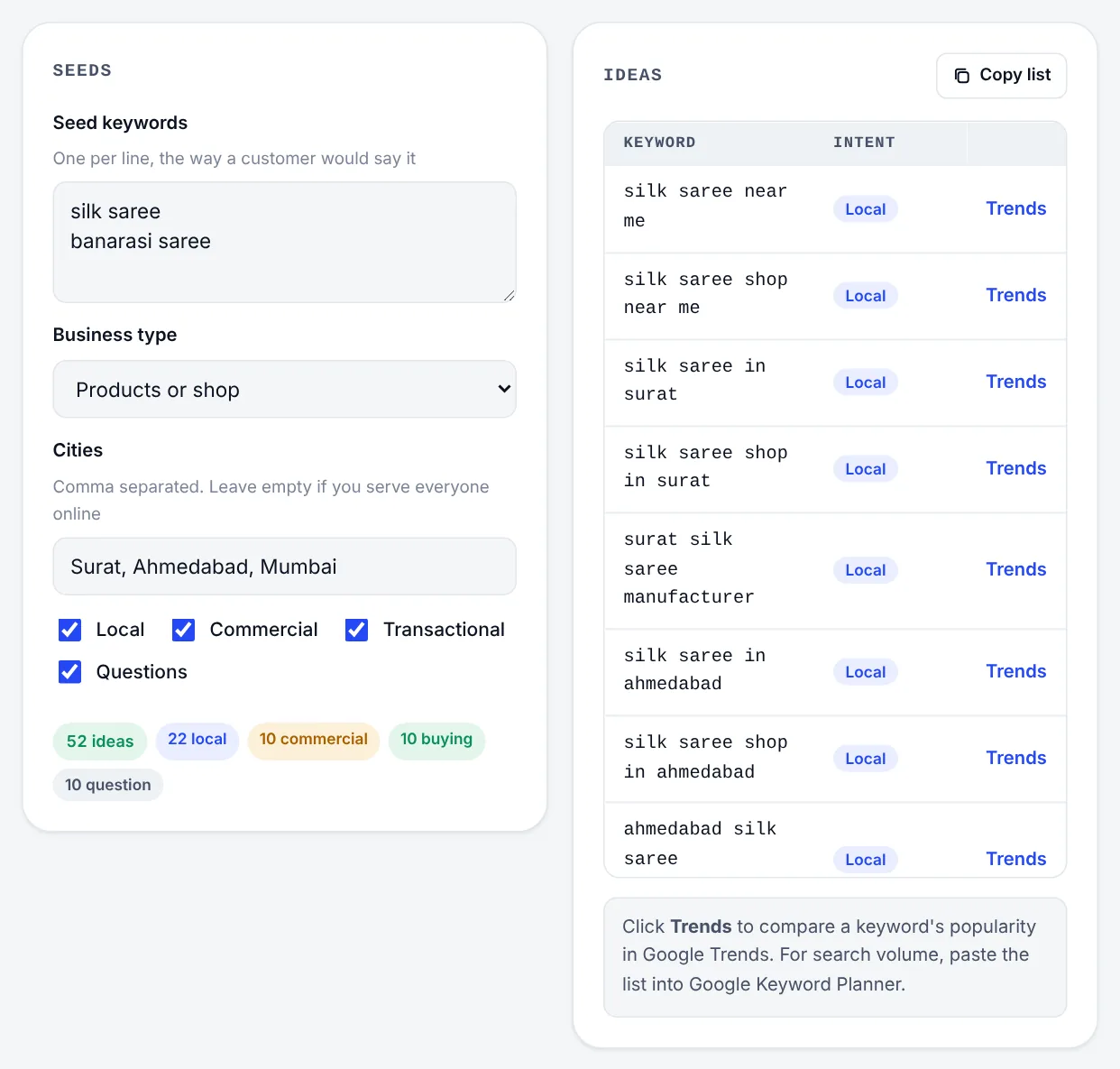
The keyword ideas tool generates all four groups from your seeds and cities. Then add real searches from these free sources:
- Google autocomplete: type your seed slowly, then add each letter of the alphabet after it, and note the suggestions.
- People also ask: the question boxes in results show what people want to know next.
- Related searches at the bottom of the results page.
- Google Search Console: once your site has some traffic, the Performance report lists the searches you already appear for.
Step 3: Understand search intent
Two searches can share words and want completely different things. "Silk saree" from someone ready to buy needs a product page with prices. "Silk saree care" needs a guide. Search intent is the reason behind a search, and matching it decides whether a page can rank at all. If Google shows ten guides for a keyword, a product page won't break in, however well optimised it is.
| Intent | The searcher wants to | Typical words | Best page |
|---|---|---|---|
| Informational | learn something | how, what, why, guide, ideas | Guide or blog post |
| Commercial | compare before buying | best, top, vs, review | Comparison or list |
| Transactional | buy, book or sign up | buy, price, order, book, hire | Product, service or pricing page |
| Navigational | reach a specific site | brand names, "login" | Your home page |
Local searches ("near me", "in Ahmedabad") are usually transactional or commercial with a place attached. They need a page, and a Google Business Profile, that clearly serve that area.
How to check intent
Don't guess. Search the keyword in a private window and look at page one:
- What type of pages rank? Products, categories, guides, videos, map results?
- What format? Lists, step-by-step guides, comparisons, calculators?
- What angle? Cheap, premium, for beginners?
- What else does Google show? A map means local intent. Videos mean people want to watch. "People also ask" shows the follow-up questions to answer.
Whatever most of page one has in common is the intent you need to match. Some examples:
- "how to identify pure silk saree": informational. Guides and videos rank. Write a clear guide with photos of the tests, and link to your products at the end.
- "best saree shop in surat": commercial and local. The map and lists rank. Strengthen your Business Profile and reviews.
- "banarasi silk saree price": transactional. Product and category pages with prices rank. Show prices or ranges clearly.
- "waterproofing vs tiling terrace": commercial. A fair comparison with costs, pros and cons fits.
Rankdesk itself is built around intent. Someone searching "meta tag generator" wants a tool, so that search leads to the tool page, with the guides only in the sidebar. Someone searching "how to write a meta description" wants to learn, so that leads to a guide, which links to the tool at the end. Each page has one job.
When results are mixed, half guides and half product pages, people want different things. Pick the type that suits your business, or serve both: a category page with a short buying guide at the top.
Step 4: Start with long-tail keywords
"Saree" is a huge search, and thousands of sites compete for it, including marketplaces with enormous budgets. "Banarasi silk saree for wedding under 10000" is searched far less, but by someone who knows exactly what they want. That's a long-tail keyword, and it's where small websites win.
Long-tail keywords are more specific about the product, place, budget, problem or audience. Length isn't the real test: "waterproofing contractor Bopal" is long-tail because it's specific.
Why they suit new and small sites:
- You can rank sooner. Big brands rarely build pages for narrow searches.
- The traffic converts. "Dentist in Vadodara open Sunday" comes from someone ready to book.
- They add up. Twenty pages each bringing 30 targeted visitors beat one page stuck on page five for a broad term.
- They build toward broader terms as the site gains authority.
Common kinds of long-tail keywords:
- Product plus detail: "pure silk saree with silver zari"
- Product plus place: "saree wholesale market Surat"
- Product plus budget: "kitchen sink under 5000"
- A problem: "bathroom wall damp after rain"
- A question: "how long does waterproofing last"
- An audience: "accounting software for small shops"
- A comparison: "membrane vs chemical waterproofing"
Search Console is the best long-tail source once you have traffic. It lists long searches you already appear for, often on page two, and those are your quickest wins.
Step 5: Check demand and competition
- Google Keyword Planner gives search volume ranges. It's inside Google Ads, but you don't have to run ads to use it.
- Google Trends compares the popularity of a few terms and shows seasons, such as saree searches rising before wedding season.
Small numbers aren't a reason to skip a keyword. Ten searches a month from buyers ready to order can be worth more than a thousand from students.
Then judge whether you can rank. If page one is all national brands and marketplaces, look for a more specific version. If you see small local businesses, forums or thin pages, you have a real chance.
Step 6: Group keywords into pages
Put keywords with the same intent together. "Silk saree price", "pure silk saree cost" and "silk saree rate" want the same thing, so they belong on one page. A separate page for each makes your pages compete with each other and looks thin. If two keywords want different things, they get separate pages. Questions often fit best as sections of a guide or in an FAQ on a service page.
| Page | Main keyword | Related keywords | Intent | Exists? |
|---|---|---|---|---|
| /silk-sarees | silk saree | pure silk saree, silk saree price | Transactional | Yes, needs work |
| /blog/identify-pure-silk | how to identify pure silk | silk burn test, real vs fake silk | Informational | No |
| /surat-showroom | saree shop in surat | saree market surat | Local | No |
Step 7: Use the keyword well on the page
- In the title tag, near the start
- In the H1 heading
- In the first paragraph, naturally
- In the URL, for a new page
Use related keywords in H2 headings and the text where they fit. Answer the specific question quickly, and add the details the search implies: prices for "under 10000", areas and directions for local searches, steps for "how to". Don't repeat the main phrase over and over. Modern search understands synonyms and context, and stuffing reads badly.
When intent explains a traffic problem
If a page gets impressions in Search Console but few clicks, or clicks but people leave fast, check intent first. A page answering a different question from the one people searched is a common cause, and rewriting it to match often does more than any technical fix.
A plan you can start this week
- Pick your main product or service.
- Collect 30 to 50 variations with the keyword ideas tool, autocomplete and your customers' messages.
- Check intent for the most important ones by searching them.
- Group them into 5 to 10 page ideas.
- Improve existing pages first, then write the missing ones, one a week.
- After a few months, check Search Console for new searches you appear for, and repeat.
If many of your customers search in Hindi, Gujarati or Hinglish, read the guide to Hindi and Gujarati keywords next.